
Academic library strategy & sustainability
A clearer future for your academic library.
As financial pressures reshape your academic library, it is difficult to see what exactly is changing. What do these changes mean for teaching, learning, and research? Understand how your library’s resources, services, and expertise fit together, and build a practical path toward a sustainable future.
Library Operating Model
When Institutional Finances Tighten:
- Pressure to sustain or increase access to scholarly resources remains, even as library budgets shrink.
- Difficult questions arise about what to change and what to preserve.
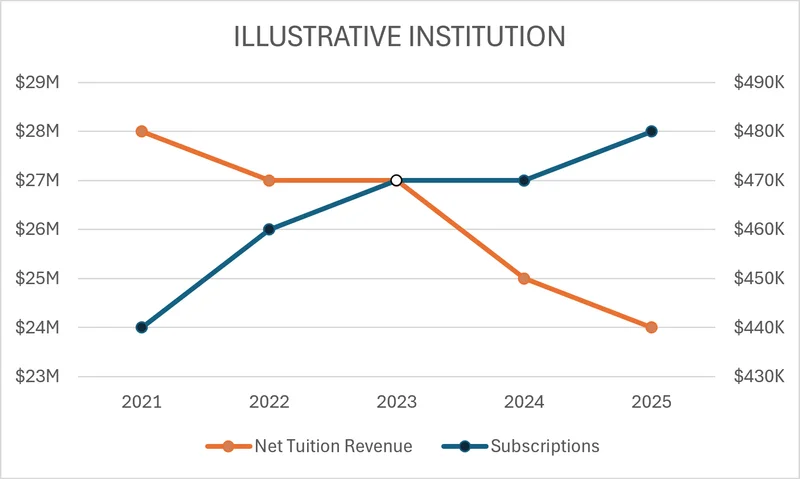
Hypothetical data
The decisions ahead
Three questions institutions face
- 01
What must we protect?
Identify the expertise, services, and relationships essential to your institution’s teaching, learning, and research mission.
- 02
What can we redesign?
Examine inherited arrangements and explore better ways to organize resources, deliver services, and support academic priorities.
- 03
What can we build toward?
Define a financially viable library model that preserves essential capabilities while creating room for new possibilities.
Start here
Library Operating Model Diagnostic
A standalone starting point for institutions examining whether the library’s current arrangements fit academic priorities, available resources, and changing needs.
Examine how collections, technology, staffing, spaces, services, and partnerships work together, including essential dependencies. Identify what to protect, reinvest in, or redesign.
What you receive
- Concise executive assessment of the current model
- Near-term improvement opportunities
- Priority decisions and options for further investigation
- Reusable decision dashboard linking library resources to institutional priorities
Tangible outcomes
From analysis to action
Turn diagnostic findings into clear decisions, credible options, and a practical sequence for moving forward.
- 01
Executive decision dashboard
See financial pressures, operational dependencies, and essential capabilities together to improve decision making.
- 02
Strategic scenarios
Compare alternative operating models, their financial implications, and consequences for academic priorities.
- 03
Phased transition roadmap
Sequence changes around institutional capacity, protecting essential services while implementing sustainable alternatives.
A deliberate process
Clarity at every stage
- 01
Understand
Clarify your library’s operations, commitments, and institutional context.
- 02
Assess
Evaluate financial viability, operational dependencies, and capabilities requiring protection.
- 03
Design
Develop practical options that align resources with academic priorities.
- 04
Implement
Guide a phased transition that preserves strengths, builds capacity, and turns possibilities into practice.
Insights
Perspectives for institutional leaders
Photo by Sasun Bughdaryan on Unsplash
Library Capacity in the Long-Term
Cutting Your Library Budget Carries Risks You Can't See
Read on LinkedIn
Photo by insung yoon on Unsplash
Academic Library Viability
Cuts to Research Libraries and What It Means for Academic Library Viability
Read on LinkedIn
Photo by Margarita Shtyfura on Unsplash
Operating Model
Are Academic Library Cuts Reducing the Existing Model or Creating a New One
Read on LinkedIn
About
Library expertise. Institutional perspective.
Timothy M. Schlak is a former library dean and associate provost who understands both library operations and institutional leadership.
I chose consulting to bring my experience in libraries, leadership, and academic affairs to institutions facing difficult choices. Through collaborative inquiry across campus, I help preserve what is essential, explore new possibilities, and develop viable alternatives.
More about TimothyBegin a conversation
Let’s clarify the decisions ahead.
Start a conversation about your library’s challenges, what matters most, and the possibilities worth exploring together.
Discuss your library